Journal
Time together7 min read
Cooking the Dish Your Partner Grew Up On
Turn a food memory into a shared Saturday: questions that bring a taste back, ways to find a recipe nobody wrote down, swaps for shops in Germany, Austria and Switzerland, and what to do with ‘nearly’.
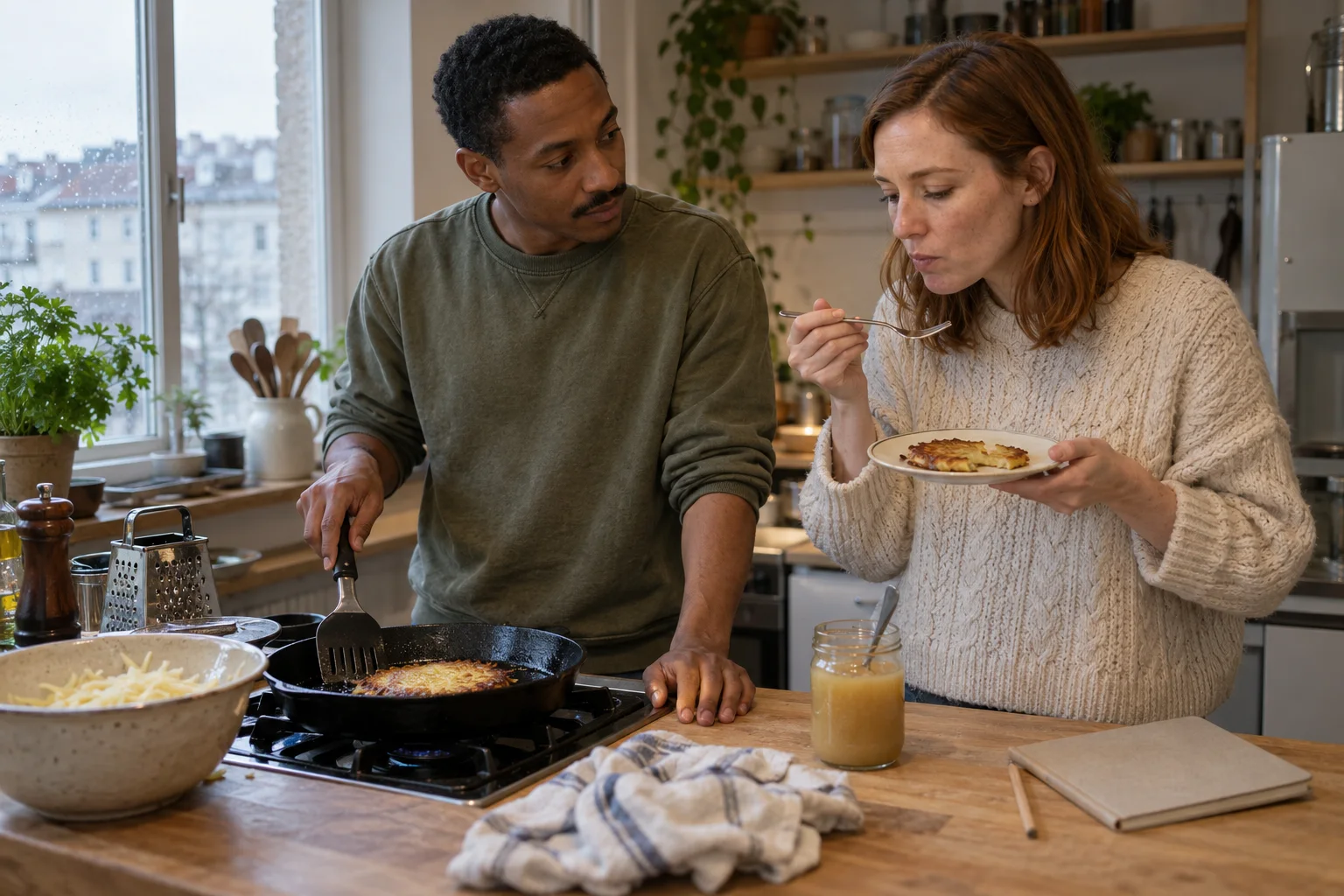
Your partner mentions the potato pancakes again: crisp edges, apple sauce, eaten standing up in the kitchen. So this Saturday you make them together. One of you cooks, the other remembers and tastes, and between you, you get from “they were sort of brown” to a plate that earns a nod. You need a pan, ingredients for several attempts, a notebook and better questions than “What was it like?”
Pick the dish that comes up unprompted
The right dish is usually the one that surfaces without anyone asking. “Nobody makes lentil soup like my grandmother.” “We had these every Friday after swimming.” It might be potato pancakes, a Sunday dal, a sponge pudding with custard from a packet, or the cheesecake an aunt brought to every birthday.
Make it a joint project rather than a surprise. The memory of the taste lives in one person’s head, so that person needs to be in the kitchen. One of you cooks, the other is the palate, and whoever does the stirring, the final say on “Is this it?” stays with the one who remembers.
Pick an afternoon with nothing riding on it: no anniversary, no friends coming for dinner. A grey Saturday, cheap ingredients and room to get it wrong a few times. Use a weekday evening in the kitchen for the questions, call the relatives the same week, shop on Friday, and keep Saturday for the stove.
Questions that bring a taste back
“What was it like?” usually gets “Good. Crispy.” The memory is there, but it’s filed under the kitchen, the pan and the day of the week rather than under “recipe”. So ask around it.
Do the asking on that weekday evening in the kitchen, with something to smell close by: fat warming in a pan, half an onion grated, the jar of apple sauce open. A real smell often reaches further back than words do.
The kitchen
- “What did it smell like when you came through the door?”
- “Which pan was it? The heavy black one? Did the handle wobble?”
- “Could you hear it frying from the other room?”
The plate
- “What colour were the edges? Darker than this toast?”
- “Thick or thin? Did they bend or snap?”
- “What came with it, and was that homemade or from a jar?”
The occasion
- “When did you get it? Was it a treat or just a Tuesday?”
- “Who cooked, and who was allowed to help?”
- “Did anything come out of a packet, a tin or a bottle?”
That last question matters. A stock cube, a splash of Maggi, margarine instead of butter: nobody writes these into a recipe, because nobody thought of them as cooking.
When words run out, compare with something you can taste today. Saltier than these crisps? Sourer than this yogurt? Write the answers down; they’re your specification. And leave room for detours. “Who was allowed to help?” can turn into twenty minutes about a brother who always stole the first one, and that’s part of the evening too.
When you can’t ask whoever used to make it
Sometimes that person has died, or the kitchen the dish came from wasn’t a happy place. Then the person who remembers decides whether this becomes a project and who gets asked. A dish can be a gentle way to talk about someone; it can also be too much for a Saturday.
Ask the others who ate it
Siblings, cousins and the neighbour who was always in that kitchen may each hold a piece. Small, answerable questions get further than “Do you have the recipe?”:
- “Did she grate the onion or chop it?”
- “Roughly how much flour: a spoon or a handful?”
- “Did you squeeze the potatoes out in a tea towel?”
- “Which apple sauce did you buy?”
Better still, ask someone to cook it on a video call while you watch their hands. If the family lives a few time zones away, that call can be its own small occasion, and you might end up asking: “Next time you make it, ring us first.”
Search with the family’s word for it
Local names find local versions. Potato pancakes alone have a string of regional names: Reiberdatschi in Bavaria, Rievkooche in Cologne, placki in Poland. Search with the exact word your partner grew up saying, and you’re more likely to find recipes from people who grew up with the same version.
Find the book that was on the shelf
A family recipe may have started in an ordinary cookbook and drifted from there. Ask which one stood on the shelf at home (in plenty of German kitchens it was the Dr. Oetker Schulkochbuch, in many American ones Joy of Cooking), then look for a second-hand copy from the years your partner remembers. Read the recipe together and spot where the family went its own way.
When an ingredient doesn’t exist here
Replace an ingredient by what it does, not by its name. Work out whether it brings fat, sourness, lift or starch, then shop for that. In shops in Germany, Austria and Switzerland, these usually work:
| From home | What it does | Try instead |
|---|---|---|
| Smetana | Tangy richness | Schmand or saure Sahne (also sold as Sauerrahm). In soups, stir it in once they’re off the boil, so it doesn’t curdle. |
| Self-raising flour | Flour with the rise built in | Plain flour plus baking powder (Backpulver), about 1½ teaspoons per 150 g, sifted together |
| Potatoes named by variety, like Russet or Maris Piper | Both are floury: they go soft when cooked | Floury potatoes, sold as mehligkochend. In general, shop by cooking type rather than variety; waxy ones are festkochend. |
| A stock cube, ketchup or spice mix from home | The background taste nobody mentions | A shop that imports from the dish’s country of origin, or two packets in the suitcase after the next visit |
Swap as little as you can at once and note every swap, so you know what to blame.
Cook in rounds, with the taster in charge
Don’t cook the whole batch at once. Make one test pancake, a small pot or a single portion, and let the one who remembers taste before you go on. It will sound something like this:
“More salt.”
“Better. No, the edges were darker.”
“Thinner. She used to flatten them with the back of the spoon.”
Change one thing per round: salt, heat, thickness or the amount of fat. Keep the notebook by the stove and give each round a line: “Round 2: more salt. Better, edges too pale.” “Round 3: hotter pan. Darker. Too thick.” Without notes, round four turns into a guess about what round two did.
Give the person who remembers a job they remember, too: grating, wringing the potatoes out in a tea towel, opening the jar of apple sauce. Doing it, and smelling the first pancake hit the fat, may bring back a detail the questions missed.
Then eat it the way it was eaten. If that meant standing at the counter, straight from the pan, stand at the counter.
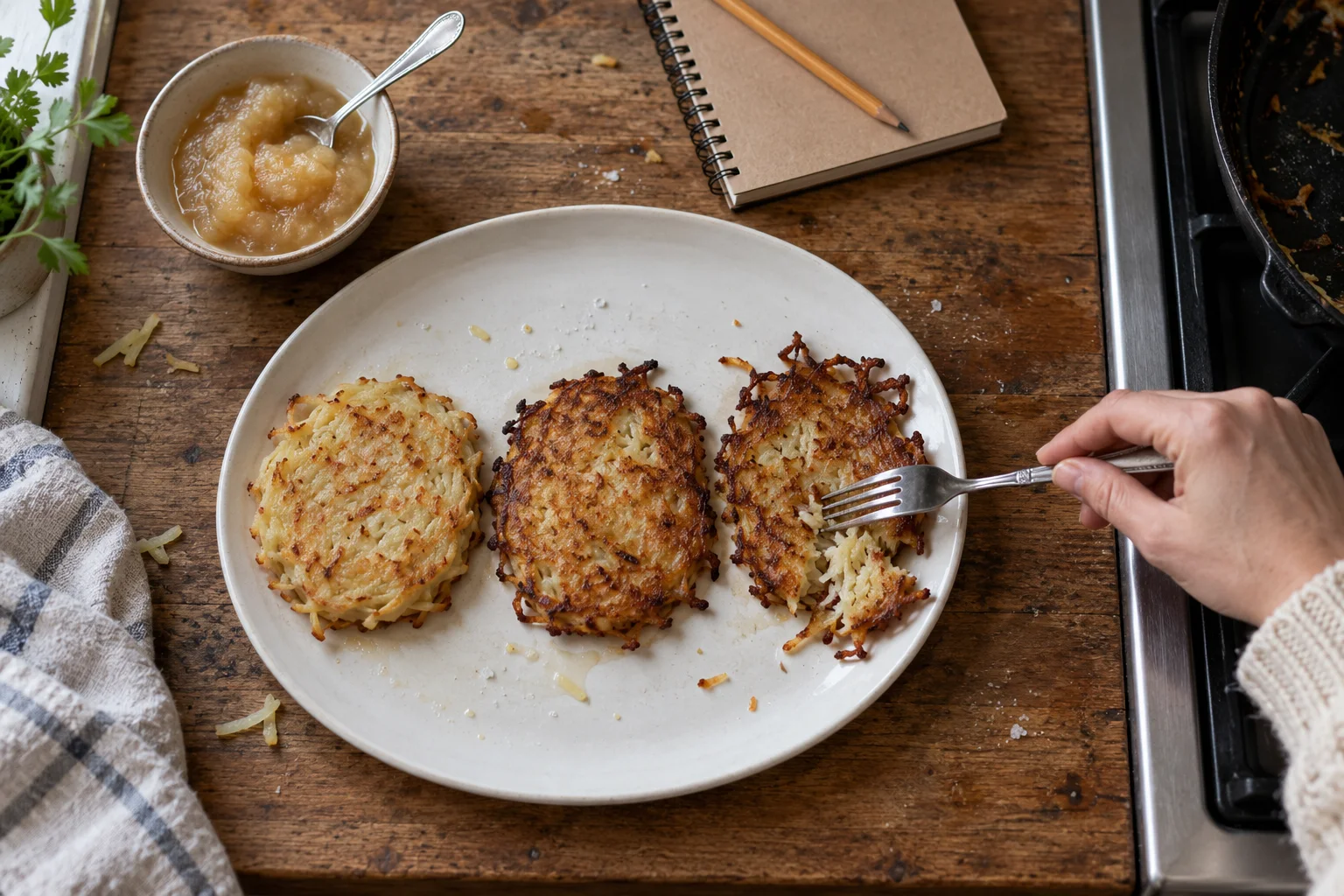
When it’s close, but not quite it
Round four is good, and the verdict is “Nearly.” Some of that gap can still close. Ask for one word for what’s missing (salt, fat, sour, crunch, burnt), because one word points to one change. Two culprits are easy to overlook:
- The kind of fat. Lard, dripping, margarine and butter all taste different, and the “wrong” one may have been the flavour.
- The pan. A thin pan browns differently from a heavy cast-iron one. If the old pan is still in someone’s cupboard, borrow it.
Some of the gap won’t close. Nobody in the kitchen is eight, nobody just walked home in the rain, and the person at the stove is someone else. That isn’t the recipe failing.
So at some point, stop chasing. Write a card for the version you’ve got, in both your handwriting, and give it a name: “Saturday pancakes, our version.” The next grey Saturday, it’s no longer a reconstruction. It’s something you two make. And there’s a fair chance the other one of you has a dish they keep mentioning, too.
Small things, thoughtfully shared.
The Knowna journal