Journal
Time together7 min read
Twelve doors each: an Advent calendar for two
A homemade Advent calendar for two: you fill the odd doors, your partner the even ones. Door ideas that cost almost nothing, a plan that lasts to the 24th, and how it works on days apart.
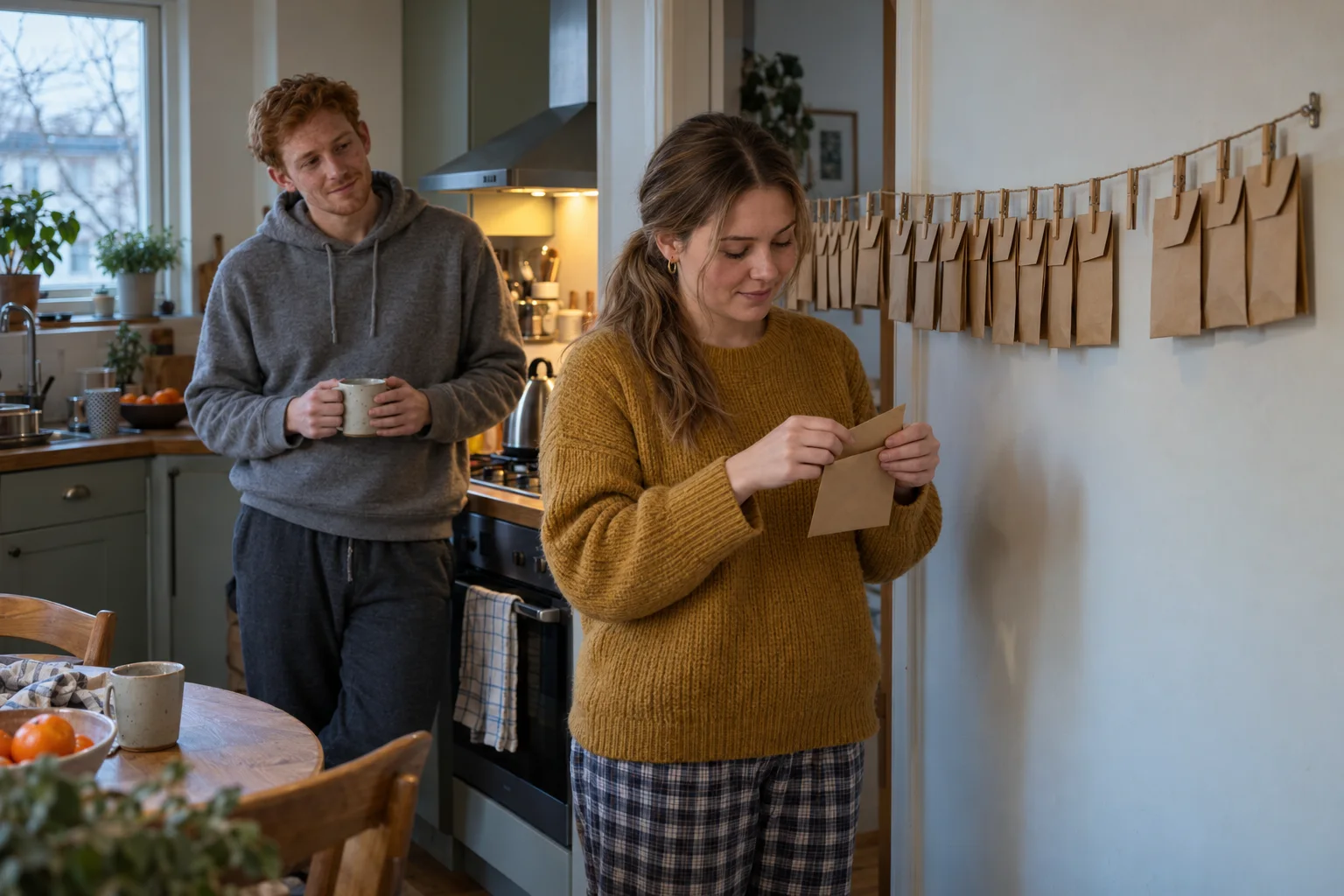
Twenty-four numbered envelopes on a string by the kitchen door. You fill the odd numbers, your partner fills the even ones, and neither of you knows what’s behind the other’s doors until the morning one opens. Each of you writes twelve and opens twelve, and almost nothing has to be bought. Each door holds a memory with a detail only you’d keep, a question for the evening, a ten-minute plan or something you came across this week.
Odd numbers, even numbers, one string
Advent starts on Sunday 29 November this year, but homemade calendars usually just run from 1 to 24 December. So treat this as a December countdown, whether or not Advent means anything to either of you, and hang it up that last weekend of November.
You need 24 small envelopes or paper bags, a pen, string and pegs. Number the envelopes. Instead of string and pegs, a shoebox or a jar works too. Whoever wants the last word writes the even-numbered doors, because door 24 is theirs.
The rule is simple: you open each other’s doors, never your own, at breakfast or whenever you’re up. An envelope can hang empty until the night before, and nobody peeks.
If you live apart, swap sealed bundles in November, by hand or in the post, and each of you hangs the twelve you’ll open. Memories and questions go in finished. For the doors you can only write in December, the small finds and the plans that depend on the day, the envelope holds a single line: ‘Look at your phone at 8.’ The door itself arrives that morning as a photo or a message, written the night before and scheduled if their eight o’clock is your middle of the night.
If you move the calendar entirely onto your phones, skip the shared note: it shows the whole month to both of you at once. Keep your twelve in a private note instead and send each one on the morning it’s due.
The 2026 calendar is kind to this split. The weekends fall on 5–6, 12–13 and 19–20 December, so each of you writes three weekend doors, which is where the longer plans go.
Twenty-four too many for your December? Do every second day and take turns filling them, or weekends only. Or one of you fills twelve doors for the other this year, and next year you swap.
Memory doors: the detail the photos missed
A memory door names a moment and adds what only you would have kept.
- A printed photo from your first winter, with a line on the back: ‘You’d just burnt the rice. We had crisps for dinner and called it a picnic.’
- The ticket from the concert where you spent two hours behind the tallest man in the building.
- ‘Our first proper argument was about how to load a dishwasher. You were right. I’ve never said so.’
- ‘The night bus home from your cousin’s wedding, when you fell asleep on my shoulder with your shoes in your lap.’
The best ones turn into a plan. Door 9 opens on a Wednesday and books the weekend: ‘Saturday, 10 a.m., the bakery where we waited out the rain.’
New couples aren’t short of material. A memory from September counts, and so does the first time you made each other laugh on purpose.
Question doors: opened at breakfast, answered tonight
A question in the morning gives the day something to come back to. Ask what you genuinely don’t know yet:
- ‘What did you want for Christmas when you were nine, and did you get it?’
- ‘What did your family eat on the 24th, and who was in charge?’ If you grew up in different countries, this one can take all evening.
- ‘Which December smell takes you straight back to where you grew up?’
- ‘Who do you talk about all the time that I’ve still never met, and what should I know before I do?’
- ‘What would you keep from your family’s December, and what would you quietly drop?’
If a question would make either of you sit up straighter, it reads like a form. Rewrite it until it sounds like something you’d ask over the washing-up.
Ten-minute plans that fit the day they land on
Look at what the day already holds before you write one. Thursday’s door shouldn’t propose a walk if Thursday is the late shift.
- ‘9 p.m., balcony, coats on, hot chocolate, no phones. Ten minutes.’
- ‘Walk home the long way tonight, past the house with the inflatable reindeer.’
- ‘I’m reading you the first chapter of the book I keep going on about. You’re allowed to fall asleep.’
- ‘One song each: the one that was always on in your kitchen in December.’
- ‘Back to bed. Coffee’s coming.’
Anything longer than ten minutes belongs on a weekend door, or gets announced early, the way door 9 does.
Small finds: something you came across, not something you shopped for
This is the door that keeps the calendar alive in week three, because you can’t write it in November. Leave a few of yours blank on purpose and fill them from the week you’re actually having. If it doesn’t fit the envelope, it waits under the string.
- A clementine with its leaves still on, from the stall outside the station.
- A pine cone from the lunchtime walk, with a note of where you found it.
- ‘The man on the 8:12 was knitting an entire scarf. Thought you should know.’
- A colleague’s family biscuit recipe, copied out by hand, with ‘Sunday? You weigh, I’ll eat the dough.’
- The postcard from the museum shop on the afternoon you went alone.
A rough test: if it cost more than a coffee, it’s a present, and that’s a different calendar.
One evening in November, so nobody writes at midnight
Plan separately, in the last week of November, with your twelve numbers and a look at December: the late shifts, the office party, the weekend at your sister’s. If your bundle travels by post, sit down a week or two earlier, or it won’t arrive by 1 December.
- Pencil a type next to each of your numbers, on a scrap of paper rather than the envelopes. Three of each is a fine start, and the scrap lets you spot when two questions land back to back.
- Write the memories and questions that evening. They don’t depend on what December brings.
- Leave the finds and most plans blank. Keep a running note on your phone of things that would make a good door, and fill each envelope the night before.
- Write two spares, a memory and a question, and keep them in a drawer. When a Tuesday goes sideways, one of them goes in, and nobody is writing a door on the back of a receipt at midnight. If you live apart, the envelope is hanging at your partner’s, so send the spare as a photo.
- Set one reminder for Sunday evenings to look at the week’s doors.
A door that opens a day late is still a door.
Days apart: doors that travel
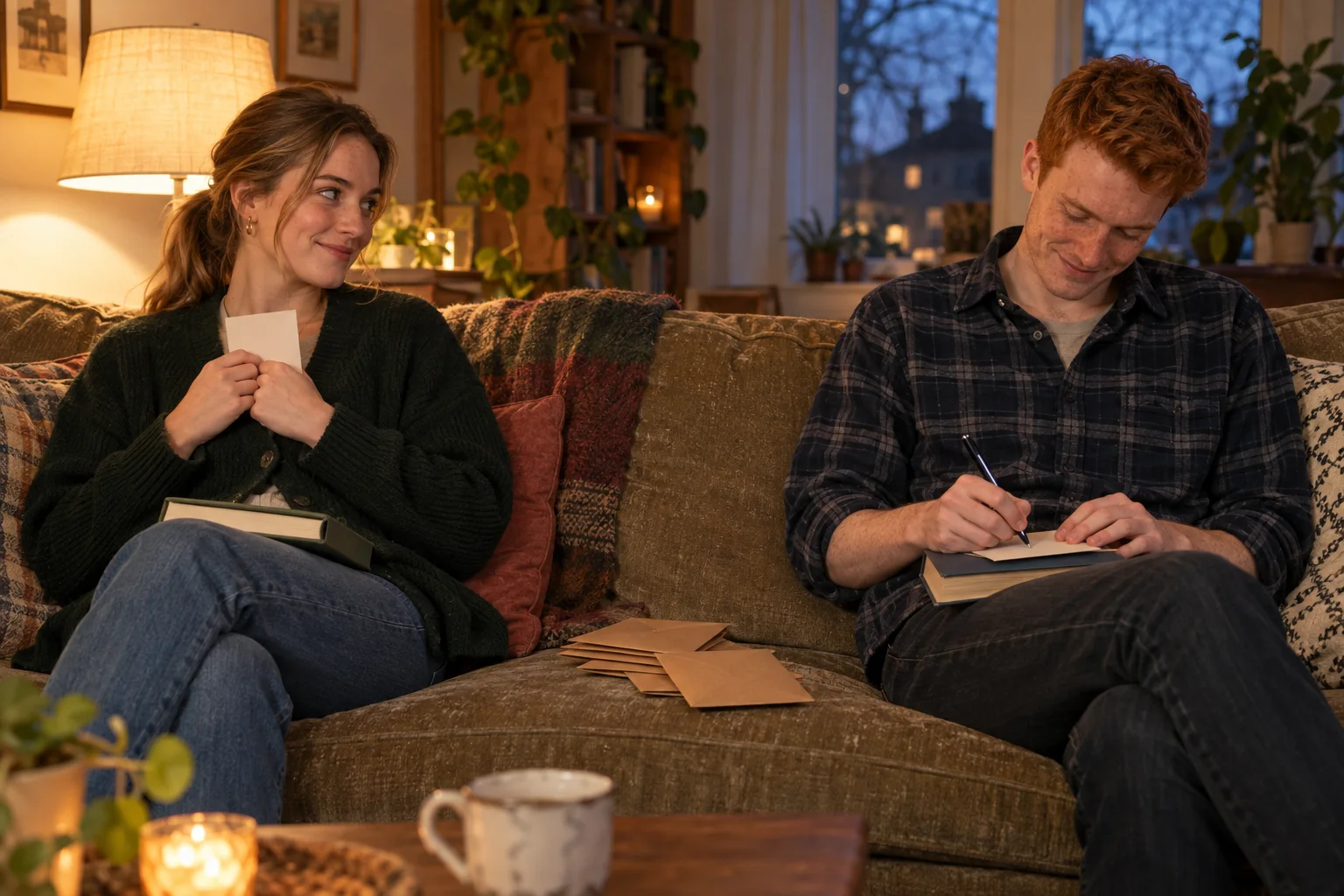
Paper doors pack easily. Before a trip, the one staying home hands over the sealed doors for the days away, and the one leaving fills theirs for home and leaves them on the string. A find or plan you’d normally write the night before goes in as a slip that says ‘Look at your phone at 8.’ Door 15 gets opened in a hotel room, door 16 by the kettle at home.
Some doors change shape on the way:
- Questions become that evening’s phone call.
- Plans become the same thing in two places: ‘9 p.m., on the phone, both of us with the same chocolate. Yours is in the side pocket of your bag.’ Or: ‘Find the nearest Christmas lights and send me one photo.’
- Finds get easier: the local biscuit, the view from the platform, the hotel’s terrible painting. The photo arrives that morning, and the biscuit comes home in a coat pocket.
On phones, write the door the night before, or before you leave, and schedule it for their breakfast. If you both use iMessage, Messages on iPhone can send it later: tap the + button, then Send Later (depending on your menu, you may have to tap More first), and pick the time. It still goes out if your phone is off or offline by then. In Google Messages on Android, touch and hold the send button and choose a time; if your phone is offline at that moment, the message waits until it’s back online.
On the 25th, keep the cards
Put the cards and notes in one envelope with a rubber band round it, in the box with the decorations. If your doors were messages, copy them into a single note with a name you’ll find again, like ‘Doors 2026’. Next November, read last year’s before you write this year’s. You won’t ask the same question twice, and it’s a good evening in its own right.
Small things, thoughtfully shared.
The Knowna journal